
Introduction: The Universe Looked Back — and It Was Nothing as We Expected
There is a particular kind of silence that falls over a room full of scientists when data arrives that does not match any of the models they spent careers building. It is not the silence of defeat. It is something more complex — a mixture of disorientation, excitement, and the dawning recognition that the universe has just revealed itself to be stranger and richer than the best human minds had managed to predict.
That silence has fallen, repeatedly, since the James Webb Space Telescope began returning science data in the summer of 2022. Image after image, observation after observation, Webb has delivered findings that have surprised, delighted, and in several cases genuinely troubled astronomers — not because the telescope is malfunctioning, but because it is working perfectly, and what it is showing them contradicts assumptions so deeply embedded in cosmological theory that revising them will take years of careful work.
The James Webb Telescope’s latest images are not just beautiful, though they are among the most beautiful photographs ever taken by any instrument in the history of science. They are scientifically explosive — carrying embedded within their light the seeds of theoretical revolutions that researchers are still struggling to fully process. From galaxies that formed when the universe was barely a toddler, to the atmospheric chemistry of worlds orbiting distant stars, to the intricate internal anatomy of stellar nurseries that were hidden from every previous telescope, Webb is forcing a wholesale reassessment of what we thought we knew about the cosmos.
Here is a guided tour through the most stunning and scientifically significant of the James Webb Telescope’s latest images — and the discoveries that have left the astronomical community genuinely shaken.
1. The First Deep Field: A Universe Teeming With Galaxies in Every Direction
On July 11, 2022, President Biden unveiled the first official science image from the James Webb Space Telescope at the White House — a moment that crystallized, for a broad public audience, just how different this observatory was from everything that had come before it. The image, known as Webb’s First Deep Field, showed the galaxy cluster SMACS 0723 as it appeared 4.6 billion years ago, surrounded by arcs and smears of light that were themselves far more distant — galaxies whose light had been gravitationally lensed and magnified by the cluster’s enormous mass acting like a natural cosmic telescope.
What struck astronomers immediately was not just the depth of the image — though reaching back 13 billion years in a single exposure was itself extraordinary — but the sheer density of the universe it revealed. Every fuzzy smear, every elongated arc, every tiny point of reddish light in that image is an entire galaxy containing hundreds of billions of stars. The image covers a patch of sky approximately the size of a grain of sand held at arm’s length, and it contains thousands of galaxies. If Webb were to tile its deep field capability across the entire sky, the result would reveal hundreds of billions of galaxies — a number that collapses any lingering sense of human cosmic significance and replaces it with something harder and more wonderful: genuine awe at the scale of what exists.
What the Lensed Arcs Revealed
The gravitational lensing visible in Webb’s First Deep Field was not merely decorative. The stretched and magnified images of background galaxies encoded by the lensing geometry allowed astronomers to study objects so distant and so faint that no previous telescope had been able to resolve them. Analysis of the lensed galaxies revealed several objects with redshifts indicating they existed when the universe was less than a billion years old — and several of those were already far more massive and structurally developed than models predicted they should be at that cosmic age. The first image had already introduced the problem that would become a persistent theme of Webb’s science mission: the early universe was more organized, more active, and more productive than the standard cosmological model expected.
2. The Cosmic Cliffs and the Carina Nebula: A Stellar Nursery Laid Bare
Among the James Webb Telescope’s latest images, the photograph released alongside the First Deep Field that generated perhaps the most immediate and visceral public reaction was the image of the Carina Nebula — specifically, a region within it that astronomers nicknamed the Cosmic Cliffs. In infrared light, Webb penetrated the dense clouds of gas and dust that obscure this star-forming region from optical telescopes and revealed, for the first time, the interior landscape of a stellar nursery in extraordinary detail.
The image shows a landscape of towering columns of gas and dust, their upper surfaces sculpted and illuminated by the fierce ultraviolet radiation pouring from young, massive stars just out of frame above. The vertical extent of the largest columns spans several light-years. Along the surfaces and edges of these pillars, hundreds of previously unseen protostars — young stellar objects in the earliest stages of formation — are visible for the first time, their jets and outflows punching through the surrounding nebular material like tiny cosmic fountains.
What This Means for Our Understanding of Star Formation
Before Webb, our understanding of star formation was necessarily incomplete because the most critical phases of a star’s early life occur inside dense clouds of gas and dust that are opaque to visible light. We could study the conditions before and after, but the birth itself was hidden. Webb’s infrared sensitivity lifts that veil completely, allowing astronomers to observe protostars at every stage of development within their natal clouds, to measure the jets and outflows that clear material away from forming stars, and to study the role of radiation from nearby massive stars in triggering or suppressing star formation in adjacent regions. The Carina Nebula image alone generated a cascade of follow-up observing proposals from astronomers eager to apply Webb’s capabilities to stellar nurseries across the Milky Way and beyond.
3. Stephan’s Quintet: Five Galaxies in a Violent, Illuminating Dance
Another of the landmark images released with Webb’s first official science package was a mosaic of Stephan’s Quintet — a compact group of five galaxies, four of which are locked in a gravitational interaction that is slowly tearing them apart and triggering waves of star formation throughout their disrupted structures. The image, the largest Webb mosaic released to that point, covered an area equivalent to about one-fifth the diameter of the full Moon and contained over 150 million pixels of data.
What made the image scientifically extraordinary was not merely its resolution — though the ability to resolve individual star-forming regions and star clusters within galaxies tens of millions of light-years away was remarkable — but what it revealed about the interaction between one of the group’s members and a shock wave of gas plowing through the intragroup medium at speeds of hundreds of kilometers per second. This shock wave, generated by the high-speed passage of the galaxy NGC 7318b through the group, is heating gas to temperatures of tens of millions of degrees and driving a cascade of physical processes that Webb’s instruments could observe in wavelength ranges never previously accessible for this target.
Galaxy Interactions and the Cycle of Cosmic Evolution
The Stephan’s Quintet observations provided one of the most detailed views ever obtained of what happens when galaxies collide — a process that has occurred billions of times throughout cosmic history, driving the growth of galaxies and the evolution of the large-scale structure of the universe. The James Webb Telescope’s latest images of this system are enabling measurements of gas temperatures, star formation rates, and the distribution of different molecular species in the shocked region with a precision that will take years to fully analyze. The data is directly relevant to understanding how the Milky Way itself was assembled through mergers and interactions over billions of years.
4. The Southern Ring Nebula: Death as Seen in a New Light
Webb’s infrared capabilities revealed something entirely unexpected when it turned its instruments on the Southern Ring Nebula — a well-studied planetary nebula in which a dying star has shed its outer layers into an expanding shell of glowing gas. This object had been imaged by Hubble and studied extensively for decades. Astronomers thought they understood it reasonably well.
Webb showed them how much they had been missing. The infrared image revealed not one but two stars at the center of the nebula — one a hot, young white dwarf actively illuminating the surrounding gas, and the second a companion star previously invisible in optical wavelengths, buried in a cloud of dust that Webb’s infrared sensitivity could see through as if it were barely there. The companion star is still surrounded by a disk of dust and material, suggesting it may itself be in an active late stage of stellar evolution.
Rewriting the Story of a Known Object
This discovery carried implications that extended well beyond a single nebula. If a companion star — one that had been completely undetected by decades of observation with every previous telescope — could be hiding inside one of the most well-studied planetary nebulae in the sky, how many other stellar systems had hidden companions that previous instruments had missed? The answer, suggested by subsequent Webb observations of other nebulae and stellar systems, appears to be: quite a few. The James Webb Telescope’s latest images are not just revealing new objects — they are revealing new structures in objects we thought we already knew, systematically deepening our understanding of stellar evolution in ways that will require a comprehensive revision of existing models.
5. The Pillars of Creation: A Classic Reimagined in Infrared
Few images in the history of astronomy are more iconic than the Hubble Space Telescope’s 1995 photograph of the Pillars of Creation — three towering columns of gas and dust within the Eagle Nebula, rendered in visible light in a palette of earthy browns, greens, and blues that became one of the most reproduced scientific images ever made. When NASA announced that Webb would observe the same target, anticipation in both the scientific community and the public was considerable.
The resulting infrared image exceeded expectations in ways that were scientifically significant rather than merely aesthetic. Where Hubble’s image showed the outer surfaces of the pillars, Webb’s infrared penetration revealed the interior structure in detail, never previously visible — including dozens of young protostars embedded within the pillars at various stages of formation, their energetic outflows visible as bright red streaks punching through the surrounding material. The image also revealed that the pillars themselves are far more dynamic than their relatively static appearance in visible light suggested — actively being eroded by ultraviolet radiation from young massive stars in the surrounding cluster, with material streaming off their surfaces in slow but relentless photoevaporation.
The Science Behind the Beauty
The scientific value of Webb’s Pillars of Creation image lies partly in what it adds to our understanding of the Eagle Nebula specifically — the new protostar detections, the erosion dynamics, the internal density structure — and partly in what it demonstrates about Webb’s capabilities more broadly. If Webb can reveal this level of detail in one of the most extensively studied star-forming regions in the sky, the scientific yield from applying the same capabilities to less well-studied regions across our galaxy and others is almost incalculable. The pillars image was both a scientific result and a proof of concept, demonstrating that Webb’s infrared vision was delivering on the promise of its design.
6. Exoplanet Atmospheres: The Most Consequential Discovery Still Unfolding
Among all the categories of observation the James Webb Telescope has pursued since beginning its science mission, none carries more long-term scientific and philosophical weight than its atmospheric characterization of exoplanets. The ability to analyze the chemical composition of atmospheres on worlds orbiting other stars — to essentially take those planets’ atmospheric fingerprints from light-years away — was a primary design driver for Webb, and the results being accumulated are pushing the boundaries of what was thought possible.
Webb has detected carbon dioxide in the atmosphere of the hot gas giant WASP-39b with a clarity that demonstrated the instrument’s atmospheric spectroscopy capabilities were performing even better than pre-launch predictions. It has detected sulfur dioxide in the same planet’s atmosphere — a molecule produced by photochemical reactions driven by the host star’s radiation — confirming that Webb can detect the products of atmospheric chemistry in real time. These detections were scientifically significant for WASP-39b specifically, but their deeper importance was methodological: they proved that Webb could detect relatively trace atmospheric constituents in exoplanet atmospheres with a sensitivity that opens the door to biosignature searches in rocky, potentially habitable worlds.
The Biosignature Hunt and What Webb Has Already Hinted
The most scientifically charged atmospheric results from the James Webb Telescope involve not hot gas giants but cooler, smaller, potentially habitable worlds — and while no confirmed biosignature has been announced, the data being accumulated has generated intense and disciplined excitement among astrobiologists. Observations of the TRAPPIST-1 system — seven roughly Earth-sized planets orbiting a red dwarf star approximately 40 light-years away, three of them in the habitable zone — have begun revealing atmospheric constraints that rule out thick, Venus-like atmospheres for some of the planets, suggesting they may have thin, Earth-like atmospheric profiles. The hunt for molecules like dimethyl sulfide, nitrous oxide, and ozone in combination with oxygen in habitable-zone rocky worlds is actively underway, and the sensitivity Webb has demonstrated means that if those molecules are present at detectable levels, Webb has a realistic chance of finding them.
Frequently Asked Questions (FAQ)
Q: What are the most significant James Webb Telescope discoveries so far? Webb’s most significant discoveries include the detection of massive, structurally developed galaxies in the universe’s first few hundred million years that challenge standard galaxy formation models, unprecedented infrared imaging of stellar nurseries revealing previously hidden protostars, the detection of carbon dioxide and sulfur dioxide in exoplanet atmospheres, the discovery of a hidden companion star in the Southern Ring Nebula, and detailed mapping of galaxy interactions in targets like Stephan’s Quintet. Each of these has generated significant revisions or extensions to existing scientific models.
Q: How far back in time can the James Webb Telescope see? Webb is capable of observing objects as they existed when the universe was approximately 100 to 200 million years old — meaning it can see light that has been traveling toward us for over 13.5 billion years. This capability comes from its infrared sensitivity, which allows it to detect light from the earliest galaxies that has been redshifted to infrared wavelengths by the expansion of the universe over billions of years.
Q: Why do Webb’s images look different from Hubble’s images? Hubble observes primarily in visible and ultraviolet light, producing images in the wavelengths human eyes can see. Webb observes primarily in infrared light, which is invisible to human eyes and must be translated into visible colors for display. The color assignments in Webb images are scientifically meaningful — different colors represent different infrared wavelengths — but they are not direct representations of what the objects would look like to human vision. Webb’s infrared capability also allows it to see through dust clouds that are opaque to Hubble, revealing structures and objects hidden from optical wavelengths.
Q: Has the James Webb Telescope found any signs of alien life? No confirmed signs of extraterrestrial life have been detected by Webb. However, the telescope has demonstrated the atmospheric spectroscopy capabilities needed to search for biosignatures in exoplanet atmospheres, and observations of potentially habitable worlds, including those in the TRAPPIST-1 system, are ongoing. The detection of certain molecular combinations — particularly oxygen alongside methane or dimethyl sulfide — in a habitable-zone rocky planet’s atmosphere would represent a strong biosignature candidate, and Webb has the sensitivity to make such a detection if the signal is present.
Q: How long will the James Webb Space Telescope operate? Webb launched with enough propellant for a minimum 10-year science mission, and the precision of its launch and orbital insertion used significantly less propellant than the maximum planned, extending its theoretical operational lifetime to potentially 20 years or more. The limiting factors for Webb’s longevity will ultimately be the degradation of its instruments and components over time, but the telescope is currently performing at or above all design specifications, and NASA has expressed confidence in a long and productive science mission well into the 2030s.
Conclusion: Webb Is Not Answering Questions — It Is Revealing How Few We Had Thought to Ask
There is a test that great scientific instruments reliably pass: they make their predecessors look not wrong, but merely limited windows onto a universe whose full dimensions they could not quite reach. Galileo’s telescope did not make naked-eye astronomy false. Hubble did not invalidate ground-based observatories. But each one revealed a universe so much larger and stranger than what had come before that it permanently altered the questions scientists considered worth asking.
The James Webb Telescope’s latest images are passing that test with flying colors. The early universe is more complex than the models predicted. Stellar nurseries are more dynamic and more populated than optical observations suggested. Exoplanet atmospheres are measurably, analyzably real in ways that move the search for life from theoretical possibility to observational program. Galaxy interactions are more intricate and more consequential than their Hubble-era portraits conveyed. Dying stars harbor hidden companions that transform our understanding of their final acts.
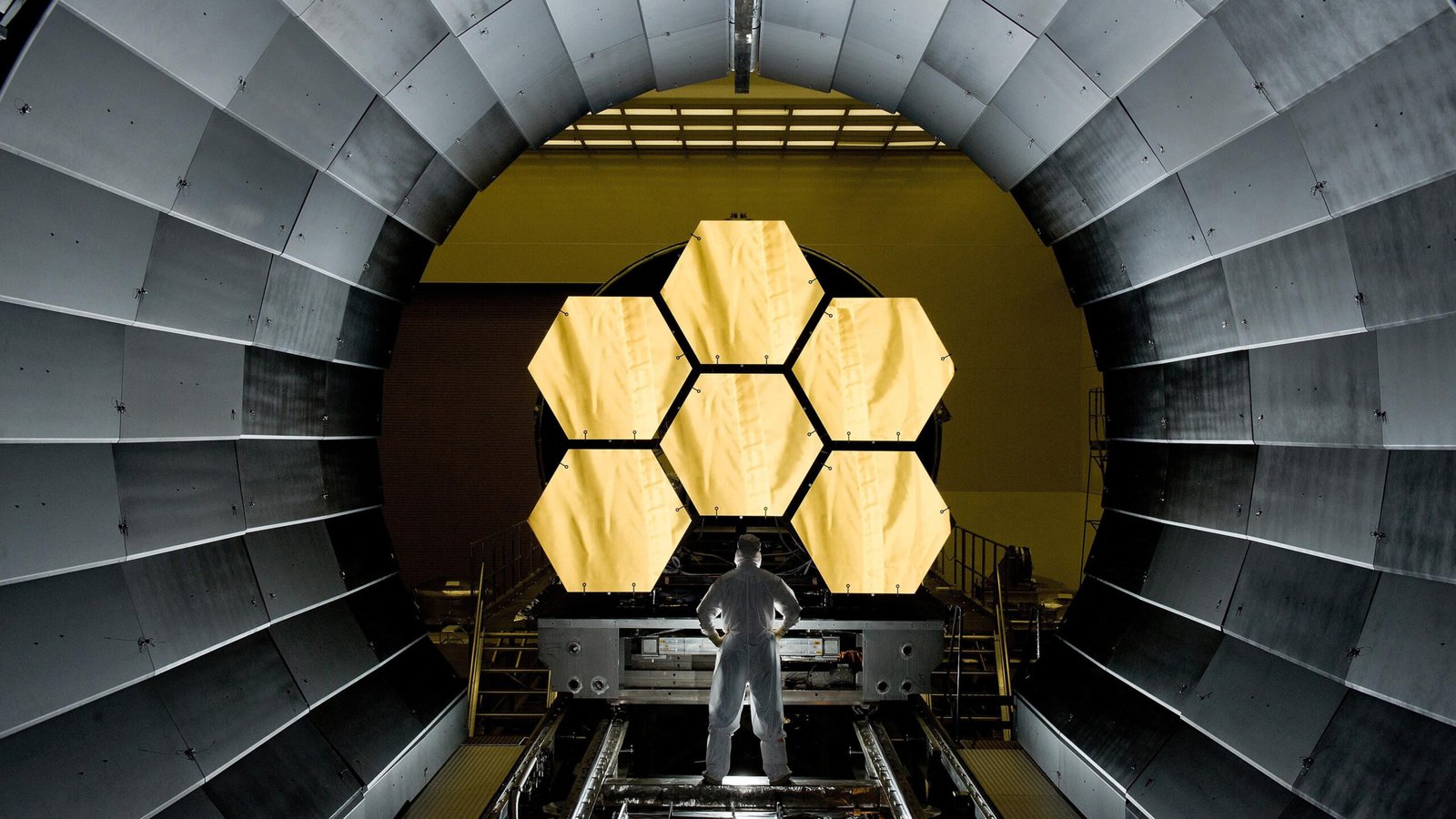
Every image Webb returns is not merely a photograph. It is a dispatch from a frontier that no human instrument has ever reached before, carrying light that has crossed the universe for billions of years to land on a mirror made of gold-coated beryllium and be translated into numbers and then into images and then into knowledge. The fact that some of that knowledge contradicts what we thought we knew is not a failure. It is the whole point. Science does not seek confirmation. It seeks truth.
And Webb, pointing its golden eye at the oldest light in the universe, is finding truth in forms and places we had not quite imagined to look.
Leave a Reply