Introduction: The Man Who Decided Humanity Needed a Second Home
In 2001, a young entrepreneur who had recently sold his first internet company sat down and began thinking seriously about what he considered the most important problem facing the human species. Not poverty. Not a disease. Not climate change — though he took all of those seriously. The problem he kept returning to was one that most people never think about at all: the permanent confinement of all human life to a single planet.
His name was Elon Musk, and within two years of that quiet reckoning, he had founded SpaceX with the declared long-term goal of making humanity a multi-planetary species. The immediate destination in his mind was never the Moon, though the Moon would prove useful. It was Mars — the fourth planet from the Sun, roughly half Earth’s diameter, with a thin carbon dioxide atmosphere, surface temperatures that swing from relatively mild to brutally cold, and a landscape of iron-red dust that stretches across a surface area equivalent to all of Earth’s continents combined.
To most people at the time, and to many aerospace engineers who had spent careers understanding the actual difficulty of spaceflight, the idea sounded like the fantasy of someone who had made too much money too quickly. Two decades later, SpaceX has launched more orbital rockets than any other organization in history, has made reusable rockets routine rather than revolutionary, has been selected by NASA to land astronauts on the Moon, and is actively testing the largest and most powerful rocket ever built — a vehicle designed, from its propellant choice to its passenger capacity, specifically for the journey to Mars.
Elon Musk’s Mars mission plan is no longer a fantasy. It is an engineering program with a timeline, a budget, a rocket, and an increasingly concrete set of technical milestones. The question of when humans will finally live on Mars has moved from the realm of speculation into the realm of scheduling. Here is the full story of what Musk is planning, how he intends to pull it off, and what standing on the surface of another world might actually look like for the first humans to call Mars home.
1. Why Mars? The Case for Choosing the Red Planet
Before examining the specifics of Elon Musk’s Mars mission plan, it is worth understanding why Mars specifically became the target of this particular vision. The solar system offers other options — the Moon is far closer, Venus is similar in size to Earth, and various moons of Jupiter and Saturn harbor potentially liquid water oceans. Why has Musk consistently pointed to Mars as the place where humanity must establish its second home?
The answer involves a combination of practical engineering considerations and philosophical conviction. Mars has a day that is almost identical in length to Earth’s — 24 hours and 37 minutes, compared to Earth’s 24 hours. It has a tilted axis similar to Earth’s, meaning it experiences seasons. Its surface gravity, while only 38 percent of Earth’s, is sufficient to maintain bone density and muscle mass far better than the zero gravity of a space station or the Moon’s 16 percent gravity. Mars has an atmosphere — thin, but present — that provides some protection from micrometeorite impacts and that could potentially be thickened over long timescales through terraforming. Most critically, Mars has abundant carbon dioxide in its atmosphere and water ice at its poles and in its subsurface, providing the raw materials needed to produce oxygen, water, and rocket fuel locally.
The Existential Argument
Beyond the practical considerations, Musk has articulated an existential argument for Mars colonization that goes deeper than engineering. He argues that any civilization confined to a single planet is inherently vulnerable to extinction — from asteroid impacts, pandemic disease, nuclear war, runaway climate change, or any number of catastrophic scenarios that could eliminate the conditions necessary for advanced life. The only insurance policy against civilizational extinction, in his framework, is establishing a self-sustaining human presence on at least one other world — a backup copy of humanity that could survive even if Earth were to suffer a catastrophic event.
This argument is not unique to Musk. Physicist Stephen Hawking made similar observations repeatedly before he died in 2018, warning that humanity’s long-term survival required becoming a space-faring species. The difference is that Musk has backed the philosophical position with billions of dollars and a working rocket program. The argument has moved from the lecture hall to the launchpad.
2. Starship: The Vehicle That Makes the Dream Physically Possible
Every element of Elon Musk’s Mars mission plan ultimately depends on a single engineering achievement: the successful development of a fully reusable, rapidly deployable heavy-lift launch system capable of carrying 100 passengers and their supplies on a seven-to-nine-month journey across interplanetary space. That vehicle is SpaceX’s Starship, and understanding its design reveals how deliberately it has been engineered for the specific demands of Mars colonization.
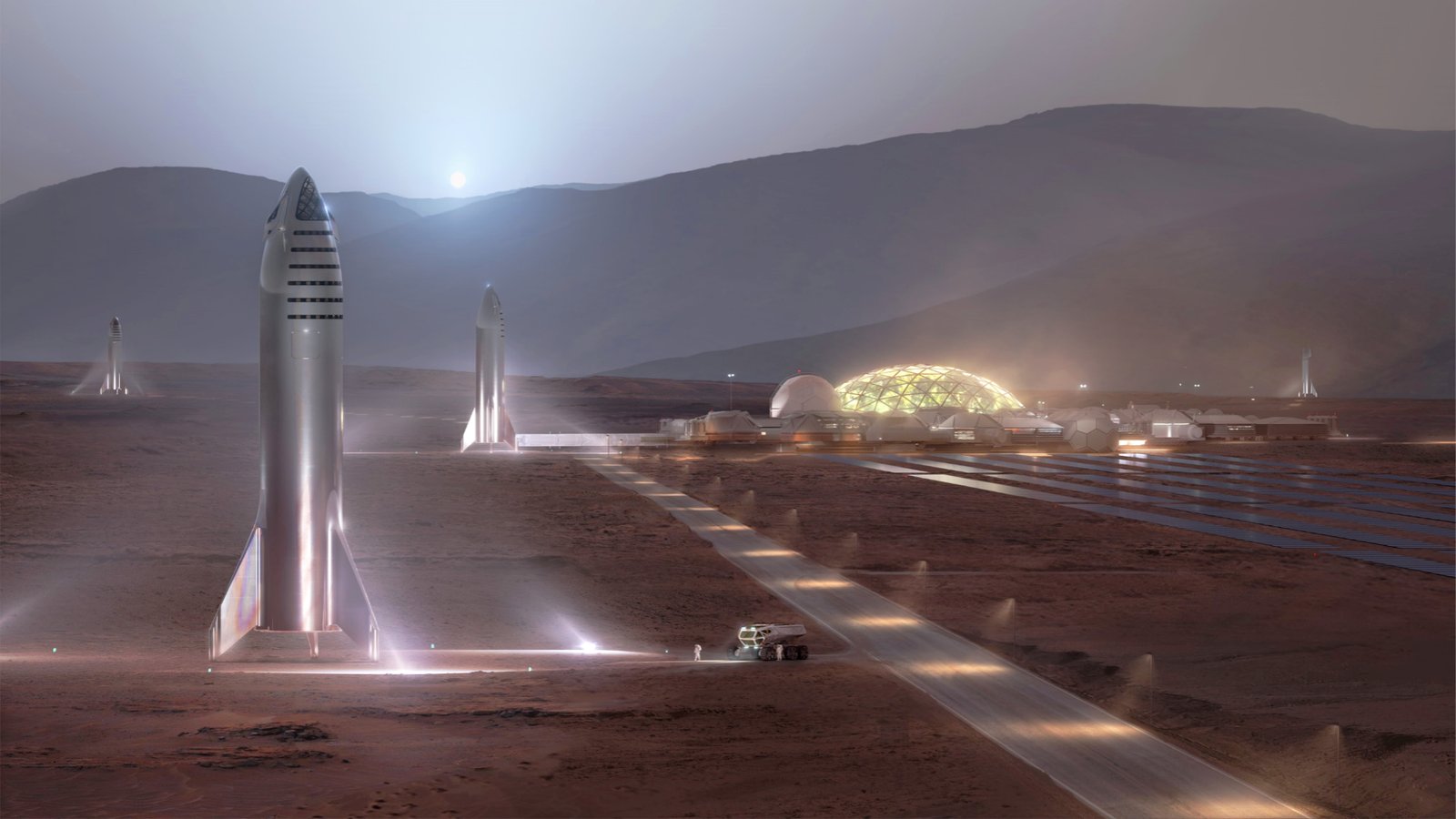
Starship consists of two stages. The Super Heavy booster — the largest rocket stage ever built — is powered by 33 Raptor engines burning liquid methane and liquid oxygen, producing approximately 7,590 tonnes of thrust at liftoff. Above it sits the Starship upper stage, a 50-meter stainless steel cylinder with its own six Raptor engines, capable of carrying up to 100 passengers in a pressurized cabin or up to 150 tonnes of cargo in its payload bay. Both stages are designed for complete and rapid reusability — the Super Heavy to be caught by the launch tower’s mechanical arms within minutes of landing, the Starship upper stage to land itself on a destination planet and be refueled for the return journey.
Why Methane Was the Right Choice for Mars
The choice of liquid methane as Starship’s propellant is not arbitrary — it is the keystone of the entire Mars architecture. Methane can be synthesized on Mars using the Sabatier reaction, which combines carbon dioxide from the Martian atmosphere with hydrogen derived from Martian water ice to produce methane and water. This means that a Starship that lands on Mars carrying passengers and cargo could, in principle, be refueled using resources manufactured entirely from Martian materials, enabling the return journey to Earth without carrying return propellant from Earth. The propellant mass required for a one-way Mars mission is a fraction of what a round trip from Earth would demand, making the entire endeavor dramatically more economically feasible than any architecture relying on Earth-origin propellant for the return flight.
3. The Timeline: What Musk Has Said and What Remains Realistic
Elon Musk’s Mars mission plan has been accompanied by timelines that have consistently proven optimistic — a pattern well-established in his professional history and one that his own team members acknowledge openly. In 2016, Musk presented an architecture that envisioned the first uncrewed Starship cargo missions to Mars as early as 2022, with crewed missions following in 2024. Those dates came and went without Mars missions launching, though the Starship development program made substantial progress in the same period.
As of early 2026, the more current and widely discussed timeline envisions the first uncrewed Starship missions to Mars targeting the 2026 launch window — the roughly one-month period every 26 months when Earth and Mars are positioned for a fuel-efficient transfer trajectory. These uncrewed missions would carry cargo, life support equipment, power generation systems, and in-situ resource utilization hardware to the Martian surface in advance of human arrivals. The goal of the cargo missions is to pre-position the infrastructure that will be needed to support a crew: power, oxygen production, water extraction, and basic habitat capability.
The First Crewed Mission: 2029 to Early 2030s
The first crewed Mars mission under Musk’s current planning targets the 2029 launch window, with subsequent crewed missions using every available launch window to progressively build up the human presence on the surface. This timeline is contingent on Starship achieving full operational maturity — including reliable landing, rapid turnaround, and demonstrated long-duration life support capability — well before the departure date. Whether 2029 proves achievable or slips to 2031 or 2033 will depend on the pace of Starship’s development over the next few years, but the direction of the program and the rate of progress make crewed Mars missions in the early-to-mid 2030s a genuinely credible target by any reasonable assessment.
4. What Living on Mars Would Actually Look Like
Romantic visions of living on Mars tend to gloss over the practical realities of inhabiting a world where the atmosphere cannot support human life, background radiation levels are several times higher than on Earth, dust storms can blanket the planet for months at a time, and the nearest emergency medical facility is, at minimum, a four-month journey away. Understanding what Elon Musk’s Mars mission plan actually envisions for daily life on the Red Planet requires confronting those realities directly.
The first habitats on Mars will almost certainly not be the gleaming domed structures of science fiction illustrations. They are more likely to be partially buried structures — either pressurized modules landed from Earth or structures 3D-printed from Martian regolith — with the Martian soil and rock providing shielding from radiation and micrometeorite impacts that no thin-walled aboveground structure could match. The interior environment would be maintained at Earth-like atmospheric pressure and oxygen content using life support systems that extract water from the soil, produce oxygen from water and carbon dioxide, and recycle breathable air through chemical scrubbing.
Food, Power, and the Necessities of Survival
Food production on Mars will require enclosed, pressurized growing facilities using hydroponics or aeroponics — soil-free cultivation methods that produce far more food per unit area than conventional agriculture and that can be optimized for the artificial lighting needed indoors. Experiments conducted on the International Space Station and in isolated ground-based habitats have demonstrated that compact growing systems can supplement an astronaut’s diet meaningfully, and scaling these systems for a permanent colony is an active area of research.
Power will come primarily from large solar panel arrays — Mars receives roughly 43 percent of the solar energy that reaches Earth’s surface, sufficient for solar power generation, though requiring larger panel areas than an equivalent Earth installation. Nuclear fission reactors, similar in concept to the Kilopower reactor NASA has been developing, offer a complementary power source that functions independently of sunlight and can provide continuous power during dust storm seasons when solar generation is severely reduced. SpaceX’s architecture envisions deploying power infrastructure with early cargo missions to ensure that power is available and reliable before any crew arrives.
5. The Path From Outpost to Self-Sustaining City
Elon Musk’s Mars mission plan does not end with the first human footstep on Martian soil. Its stated endpoint — the benchmark Musk has repeatedly described as the definition of success — is a self-sustaining city of at least one million people, large enough to maintain a viable civilization even if all contact with Earth were permanently severed. Reaching that population from the first crew of a handful of astronauts requires a sustained, exponentially growing transportation effort spanning decades.
Musk’s architecture envisions launching Starship missions during every Earth-Mars launch window — approximately every 26 months — with the number of vehicles and the size of each crew growing as Starship production scales and operational experience accumulates. In his most ambitious projections, Musk has described a fleet of thousands of Starships eventually making the interplanetary crossing during each launch window, carrying thousands of passengers per window at a cost per person that he hopes to eventually reduce to something approaching the price of a house. This vision requires not just rocket production at scales that dwarf anything in the current space industry, but also the development of a robust in-situ economy on Mars — one that can eventually produce locally most of what the colony needs, reducing its dependence on expensive Earth supply missions.
The Industrial and Economic Challenge
Building a genuinely self-sustaining civilization on Mars requires establishing local industry at a scale that has no precedent in any previous space exploration program. Iron and steel production from Martian ore, glass production from Martian silicates, chemical manufacturing from atmospheric and soil resources, electronics fabrication from extracted metals — all of these industrial capabilities need to be transplanted from Earth to Mars, adapted to Martian conditions, and operated by a workforce that initially numbers in the hundreds and must eventually grow to the millions. Musk has acknowledged that this is a multigenerational project, one that will outlive him personally and require the sustained commitment of multiple generations of engineers, scientists, and settlers.
6. The Challenges That Could Still Derail the Dream
Honesty about Elon Musk’s Mars mission plan requires acknowledging the formidable obstacles that remain between the current state of the Starship program and the first human beings stepping onto Martian soil. Several of these challenges are technical, several are biological, and several are financial and political.
On the technical side, orbital propellant transfer — refueling a Starship in Earth orbit before it departed for Mars — has not yet been fully demonstrated, though SpaceX has conducted early tests of propellant transfer between internal tanks. A Starship landing on Mars must perform a supersonic retropropulsion maneuver in an atmosphere thin enough to provide little aerodynamic braking but thick enough to complicate the entry dynamics — a regime that has never been tested with a vehicle of Starship’s size and mass. The reliability standards required for a vehicle carrying 100 humans are significantly higher than those acceptable for an uncrewed cargo mission, and demonstrating that reliability requires a substantial flight history that the program is still accumulating.
The Human Health Frontier
On the biological side, the effects of spending seven to nine months in the radiation environment of interplanetary space — beyond Earth’s protective magnetic field and outside any planetary atmosphere — on human health are still incompletely understood. Mars’s own radiation environment, while less severe than deep space, involves chronic exposure to cosmic rays and solar energetic particles at levels that Earth’s surface-dwelling humans never experience. Bone density loss, muscle atrophy, and cardiovascular deconditioning in microgravity are well-documented concerns, and Mars’s 38 percent gravity may or may not be sufficient to prevent their full development. The first human missions to Mars will be medical experiments as much as exploration missions, and the data they return will be essential for planning longer-term habitation.
Frequently Asked Questions (FAQ)
Q: When does Elon Musk plan to send humans to Mars? Elon Musk’s current stated timeline targets the first uncrewed Starship cargo missions to Mars in the 2026 launch window, with the first crewed missions targeting the 2029 window. These timelines are considered optimistic by many space industry analysts, and most independent assessments place the first realistic crewed Mars mission in the early to mid-2030s. The actual date will depend heavily on Starship achieving full operational maturity over the next several years.
Q: How long would the journey to Mars take on a SpaceX Starship? A Starship mission to Mars would take approximately 6 to 9 months, depending on the specific trajectory used and the orbital positions of Earth and Mars at the time of departure. The most fuel-efficient trajectories, used during optimal launch windows that occur every 26 months, take around 7 months. Future propulsion advances — including nuclear thermal propulsion — could potentially reduce this to as little as 45 days, though Starship uses conventional chemical propulsion for its Mars architecture.
Q: How would people survive on Mars, given its hostile environment? Mars colonists would live in pressurized, radiation-shielded habitats — likely partially buried structures using Martian regolith as shielding. Oxygen would be produced from water electrolysis and carbon dioxide reduction. Water would be extracted from subsurface ice deposits. Food would be grown in enclosed hydroponic facilities. Power would come from solar arrays supplemented by nuclear fission reactors. The entire life support system would be designed with multiple redundancies, as resupply missions from Earth would take a minimum of seven months to arrive.
Q: How much would it cost to go to Mars with SpaceX? No confirmed ticket price has been set by SpaceX. Elon Musk has stated his long-term ambition to reduce the cost of a Mars journey to approximately $100,000 per person — comparable to the median cost of a home in the United States — through full and rapid Starship reusability and economies of scale from high flight rates. Current launch costs are far higher, and achieving Musk’s target price requires the full realization of the Starship reusability architecture at an industrial scale, which remains a long-term goal rather than a near-term reality.
Q: Is Elon Musk’s Mars plan supported by NASA? NASA and SpaceX have a complex relationship that combines competition and collaboration. NASA has selected SpaceX’s Starship as the Human Landing System for the Artemis lunar program — meaning NASA is actively investing in the development of Starship for Moon missions. NASA’s own Mars exploration roadmap envisions crewed missions in the late 2030s and has been informed by SpaceX’s architectural thinking. However, NASA’s crewed Mars program is separate from Musk’s private colonization vision, and the two organizations have different priorities, timelines, and decision-making processes.
Conclusion: The Red Dot in the Night Sky Is Getting Closer
For all of human history, Mars was a light in the sky — close enough to show a reddish color to the naked eye, far enough that its true nature remained mysterious until the space age finally sent machines to look. It has been a canvas for human imagination, a destination in countless stories, a symbol of the unreachable. Children have grown up looking at it and wondering. Scientists have spent careers studying it from a distance. And one engineer, looking at that red dot and asking what it would take to actually go there, started building the largest rocket in history to find out.
Elon Musk’s Mars mission plan is not guaranteed to succeed. The technical challenges are real. The timelines may slip further. The biological unknowns may prove more difficult than current models suggest. The political and financial support required to sustain a decades-long civilizational project may waver. History is full of grand ambitions that fell short of their goals.
But history is also full of ambitions that seemed impossible right up until the moment they were achieved. Twelve human beings walked on the Moon fifty years ago using computers less powerful than a modern wristwatch, driven by a political will that focused national resources on a problem considered unsolvable. The resources, technology, and institutional knowledge available today dwarf what existed in 1969. And for the first time in history, the effort to reach Mars is being driven not by national pride or geopolitical competition but by something arguably more durable: the conviction of a small number of people that human civilization must not bet everything on the continued good fortune of a single planet.
Mars is approximately 225 million kilometers away on average. In human terms, it is unimaginably far. In terms of what SpaceX is building and what NASA is planning, it is the next stop on a journey that has only one direction.
Outward.
0 thoughts on “Elon Musk’s Mars Mission Plan: When Will Humans Finally Live on Mars?”