

Introduction: The Moon That Might Not Be Alone in the Dark
It sits roughly 628 million kilometers from Earth, locked in a gravitational embrace with the solar system’s largest planet, perpetually bombarded by radiation so intense it would kill an unprotected human being in less than a day. Its surface is a fractured, criss-crossed expanse of ice, sculpted into strange ridges and reddish-brown streaks by forces that planetary scientists are still working to fully understand. From a distance, Europa — the fourth largest of Jupiter’s 95 known moons — looks hostile, frozen, and lifeless.
But beneath that icy shell, something extraordinary is almost certainly happening.
Scientists have accumulated decades of evidence suggesting that Europa harbors a vast liquid water ocean beneath its frozen crust — an ocean estimated to contain twice as much water as all of Earth’s oceans combined, kept liquid not by proximity to the Sun, but by the relentless gravitational squeezing of Jupiter and its sibling moons generating heat deep inside the moon’s rocky interior. Where there is liquid water, there is at a minimum the possibility of life. And on Europa, the evidence for liquid water is not tentative — it is robust, multi-layered, and growing stronger with every new mission and every new analysis of existing data.
The question of whether there could be life on Europa is no longer a fringe topic in astrobiology. It is a mainstream scientific priority, one that NASA has committed billions of dollars and decades of mission planning to investigate. New evidence revealed in recent years has pushed the conversation forward dramatically, transforming Europa from a promising candidate into arguably the single most compelling target in the search for life beyond Earth. Here is what we know, what we suspect, and why the next decade of exploration could deliver the most consequential scientific answer in human history.
1. Europa’s Hidden Ocean: The Foundation of Everything
The story of life on Europa begins with water — specifically, the enormous body of liquid water believed to exist between Europa’s icy surface and its rocky mantle. The evidence for this subsurface ocean is among the most compelling in planetary science, built from multiple independent lines of observation spanning nearly three decades.
The first strong hints came from NASA’s Galileo spacecraft, which orbited Jupiter from 1995 to 2003 and made repeated close flybys of Europa. Galileo’s magnetometer detected a magnetic signature around Europa that was consistent with a conducting liquid layer — most likely saltwater — beneath the moon’s surface, responding to Jupiter’s powerful magnetic field as the moon moved through it. This was not a weak or ambiguous signal. It was exactly what you would expect to see if a global ocean of electrically conducting liquid existed within a few kilometers of the surface.
Supporting evidence came from Galileo’s imaging cameras, which revealed a surface landscape unlike anything seen elsewhere in the solar system. Europa’s ice is covered in a dense network of ridges, bands, and fractured regions called chaos terrain, where the surface appears to have broken apart, shifted, and refrozen repeatedly. These features are most naturally explained by a warm or liquid layer beneath the ice, allowing the surface to flex and fracture in response to tidal forces. The reddish-brown material filling the cracks — still not fully identified — appears to have welled up from below, carrying chemistry from the interior to the surface.
How Deep and How Warm?
Current best estimates suggest Europa’s ocean lies beneath an ice shell somewhere between 10 and 30 kilometers thick, making direct access challenging but not impossible with appropriate technology. The ocean itself is estimated to be between 60 and 150 kilometers deep, making it by far the largest ocean in the solar system by volume. The heat maintaining this ocean in a liquid state comes primarily from tidal flexing: as Europa orbits Jupiter in a slightly elliptical orbit influenced by the other Galilean moons, the gravitational stretching and compressing of its interior generates frictional heat. This same process almost certainly drives volcanic or hydrothermal activity on the rocky seafloor — and it is at those hydrothermal vents, many scientists believe, where the most interesting chemistry might be occurring.
2. Hydrothermal Vents and the Recipe for Life
The discovery in 1977 of hydrothermal vent ecosystems on Earth’s ocean floor was one of the most transformative moments in the history of biology. Before that discovery, life was understood to be fundamentally dependent on sunlight — on the photosynthetic chain that ultimately powers almost every ecosystem on Earth’s surface. The vent communities shattered that assumption completely. At crushing depths, in total darkness, in water heated to hundreds of degrees by volcanic activity and rich in chemical compounds toxic to surface life, entire ecosystems thrived — bacteria, tube worms, shrimp, crabs, and more — all powered not by sunlight but by chemosynthesis, the metabolic processing of chemical energy released by the interaction between hot, mineral-rich vent fluid and cold seawater.
For Europa, the significance of this discovery cannot be overstated. The conditions that power hydrothermal vent life on Earth — liquid water, a rocky seafloor, chemical energy released by geological processes — are precisely the conditions scientists believe exist at the bottom of Europa’s ocean. If the rocky mantle beneath Europa’s ocean is being heated by tidal forces sufficient to maintain liquid water above it, it is almost certainly also producing the kind of hydrothermal activity that could drive chemosynthetic life. The energy source does not require sunlight. It does not require proximity to a star. It requires only water, rock, and heat — all of which Europa almost certainly has in abundance.
The Chemical Ingredients: More Than Just Water
Life as we know it requires more than water. It requires a suite of chemical building blocks — carbon, hydrogen, nitrogen, oxygen, phosphorus, and sulfur, often abbreviated as CHNOPS — along with a source of energy and a liquid medium in which chemistry can proceed. Recent analysis of data from the Hubble Space Telescope and the Galileo mission has provided growing evidence that Europa’s ocean may be rich in many of these ingredients. The reddish material on Europa’s surface contains sulfur compounds and appears to include organic molecules — carbon-containing compounds that are the chemical precursors to biology. These materials appear to have originated from the ocean below, suggesting that the ocean’s chemistry is being continuously refreshed and exported to the surface through the moon’s active geology.
3. The Water Plumes: Europa Is Venting Its Secrets
One of the most exciting developments in Europa science in recent years has been the detection of water vapor plumes apparently erupting from the moon’s surface — geysers of water or water vapor rising from the ice into the vacuum of space above. If confirmed, these plumes would represent direct samples of Europa’s subsurface environment, potentially carrying dissolved chemicals, organic molecules, and even microbial life from the ocean below to a location where a passing spacecraft could sample them without needing to drill through kilometers of ice.
The Hubble Space Telescope detected what appeared to be plume activity at Europa’s south pole in 2012, and subsequent Hubble observations in 2016 produced additional evidence from a different location, including an apparent plume reaching an altitude of roughly 200 kilometers above the surface. Analysis of archival data from the Galileo mission later identified what may have been a plume encounter during a 1997 flyby — a detection that went unnoticed at the time because the instruments were not specifically designed to detect it, but which becomes interpretable in the context of later observations.
Why Plumes Change the Mission Strategy Entirely
The possibility of accessible plumes fundamentally transforms the practical challenge of investigating whether there is life on Europa. Drilling through tens of kilometers of ice to reach the ocean directly is an engineering challenge beyond the capability of any near-term mission. Sampling material that the ocean has ejected into space of its own accord is dramatically more tractable. NASA’s Europa Clipper mission, described in detail in the next section, includes instruments specifically designed to fly through any plumes it encounters and analyze their contents in real time — a strategy that could provide direct chemical evidence from the ocean without ever touching the surface.
4. NASA’s Europa Clipper: The Mission Built to Answer the Question
The most important development in the search for life on Europa in this generation is a spacecraft currently in transit toward Jupiter: NASA’s Europa Clipper. Launched in October 2024 aboard a SpaceX Falcon Heavy rocket, Europa Clipper is the largest planetary science spacecraft NASA has ever built, carrying nine scientific instruments specifically selected and designed to characterize Europa’s ocean, ice shell, surface chemistry, and geological activity in more detail than any previous mission.
Europa Clipper will not orbit Europa directly — the intense radiation environment near Jupiter would damage its electronics too quickly. Instead, it will orbit Jupiter itself, making approximately 49 close flybys of Europa over the course of its four-year primary mission, approaching to within 25 kilometers of the moon’s surface on some passes. Each flyby will provide a different slice of data, and the cumulative picture assembled from all 49 encounters will give scientists an unprecedented understanding of what lies beneath the ice.
The Nine Instruments and What They Are Looking For
The spacecraft’s instrument suite is a masterclass in addressing a single question from as many independent angles as possible. A mass spectrometer will analyze any gas or plume material encountered during flybys, identifying molecules and looking for organic compounds and potential biosignatures. A magnetometer will map Europa’s magnetic environment and refine estimates of the ocean’s depth, salinity, and thickness. An ice-penetrating radar will probe the structure of the ice shell and look for shallow liquid water lenses that might be closer to the surface than the main ocean. Cameras will image the surface at resolutions sufficient to identify features just a few meters across. A thermal imaging instrument will identify warm spots on the surface that might indicate regions of active geological or hydrothermal activity below.
The mission is designed not to prove that life exists on Europa, but to determine whether Europa’s ocean is habitable — whether it has the chemistry, energy sources, and physical conditions that life requires. Finding habitability would make Europa the strongest candidate for life in the solar system beyond Earth and would lay the scientific foundation for a future mission directly targeting biological detection.
5. What the James Webb Space Telescope Has Added to the Story
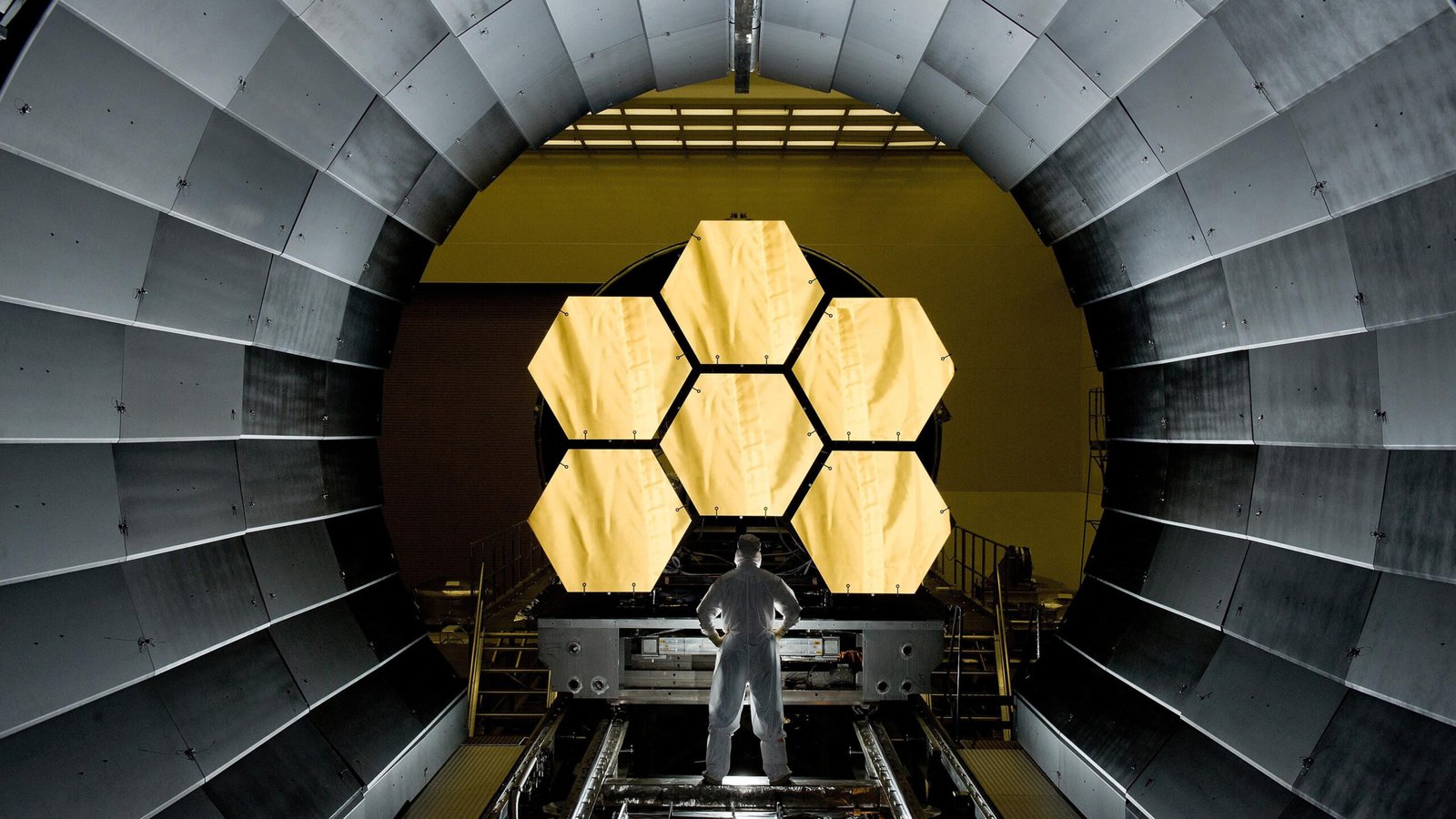
While Europa Clipper is the dedicated instrument for this investigation, the James Webb Space Telescope has already contributed significantly to the scientific case for life on Europa, and its ongoing observations continue to add detail to the picture.
In 2023, Webb detected carbon dioxide on Europa’s surface in a specific region called Tara Regio — an area of particularly chaotic and disrupted terrain. Carbon dioxide is not unusual in the outer solar system, but the specific location of this detection was striking. Tara Regio is one of the youngest-looking regions on Europa’s surface, suggesting that the carbon dioxide was recently deposited there from the interior rather than arriving from external sources like meteorite impacts or Jupiter’s magnetosphere. Carbon is one of the fundamental building blocks of life, and its presence in a form that appears to have originated in the subsurface ocean strengthens the case that the ocean contains the chemical ingredients biology requires.
Webb’s infrared sensitivity also detected what appear to be hydrogen peroxide deposits on Europa’s surface, formed by radiation breaking apart water molecules in the ice. When hydrogen peroxide is carried downward into the ocean by surface ice mixing over geological time, it can provide a chemical oxidant that reacts with compounds produced by hydrothermal vents — creating a chemical energy cycle that, on Earth, is one of the mechanisms used by chemosynthetic organisms. The detection of both an oxidant on the surface and a likely reductant source at the seafloor points toward the kind of chemical disequilibrium that life can exploit as an energy source.
6. The Broader Context: Europa in the Solar System’s Habitability Picture
Europa does not stand alone as an icy moon with a subsurface ocean. Saturn’s moon Enceladus has been actively venting water vapor and organic molecules from a confirmed subsurface ocean since the Cassini spacecraft made its dramatic discoveries there between 2005 and 2017. Saturn’s moon Titan has a surface lake system of liquid methane and ethane that some scientists consider a potential alternative solvent for exotic biochemistry. Jupiter’s moon Ganymede, the largest moon in the solar system, appears to have its own subsurface ocean detected by magnetic signatures. Even Pluto, once dismissed as a frozen, dead world at the edge of the solar system, shows evidence of internal activity that some researchers attribute to a subsurface liquid water layer.
The emerging picture is one where liquid water oceans are not rare exceptions in the cold outer solar system, but potentially common features of worlds with sufficient internal heat. This transforms our understanding of where life might be possible in the universe more broadly. If planets like Earth — warm, rocky worlds orbiting in a star’s liquid water habitable zone — are the only targets for the search for life, the number of candidates is already large. If ocean moons like Europa, Enceladus, and Ganymede are also viable habitats, the number of potentially life-bearing worlds in the galaxy increases by orders of magnitude.
Frequently Asked Questions (FAQ)
Q: What is the strongest evidence for life on Europa? There is no confirmed evidence of life on Europa yet, but several lines of evidence make it a compelling candidate. These include the confirmed existence of a vast subsurface liquid water ocean, evidence for hydrothermal activity on the rocky seafloor, the detection of carbon dioxide and organic-related compounds on the surface that appear to originate from the interior, the presence of chemical conditions similar to those supporting life at deep-sea hydrothermal vents on Earth, and the detection of possible water vapor plumes that could carry ocean material into space.
Q: When will NASA’s Europa Clipper arrive at Jupiter? Europa Clipper, launched in October 2024 aboard a SpaceX Falcon Heavy, is expected to arrive at the Jupiter system in April 2030. It will then spend approximately four years conducting close flybys of Europa, building up a comprehensive scientific picture of the moon’s ocean, ice shell, and surface chemistry. The mission is specifically designed to assess Europa’s habitability rather than to directly search for life.
Q: How thick is Europa’s ice shell, and could we drill through it? Current estimates suggest Europa’s ice shell is between 10 and 30 kilometers thick, though there is significant scientific uncertainty in this range. Drilling through it with current or near-future technology is not considered feasible for an initial mission. However, if shallow liquid water pockets exist closer to the surface — as some models predict — future missions might be able to reach them with specialized drilling equipment. Sampling material from water plumes is considered a more immediately practical approach.
Q: Is Europa the most likely place to find life in the solar system outside Earth? Many astrobiologists consider Europa and Saturn’s moon Enceladus to be the most promising candidates for extraterrestrial life in the solar system, with Europa having the larger ocean and Enceladus having the confirmed active plumes already sampled by Cassini. Mars also remains a candidate, particularly for ancient fossilized life or present-day microbial life in subsurface brines. The scientific community does not have a consensus on a single most likely candidate, but Europa consistently ranks at the top of most researchers’ lists.
Q: What happens if Europa Clipper finds signs of life? Finding definitive signs of life would be the most significant scientific discovery in human history, with profound implications for philosophy, religion, and our understanding of life’s place in the universe. In practical scientific terms, it would trigger immediate planning for follow-up missions specifically designed to characterize and study that life in detail. Europa Clipper is designed to assess habitability — confirming signs of life would require dedicated future missions with more specialized biological detection instruments. International coordination and careful ethical consideration of how to proceed would follow.
Conclusion: The Ocean Beneath the Ice Is Waiting
There is something almost unbearably poignant about the image of Europa as seen from space — that smooth, cracked, quietly glowing sphere, hanging in the darkness beside the immensity of Jupiter, carrying within it an ocean larger than all the seas on Earth, hidden beneath kilometers of ancient ice, in a darkness so complete that no light from the distant Sun has ever touched it.
Something might be alive in that darkness. Not something that thinks or builds or wonders — almost certainly not, though the universe has surprised us before — but something that metabolizes, that reproduces, that represents the fundamental phenomenon of life finding a way in conditions we once thought were impossible. The hydrothermal vents on Earth’s ocean floor taught us that life does not need sunlight. Europa may be about to teach us that life does not need to live on the surface of a planet orbiting in the right zone around the right kind of star.
If that lesson is confirmed — if Europa Clipper’s instruments or some future mission’s drill or plume sampler returns evidence of biology from that hidden ocean — then the entire framework within which humanity has understood its place in the universe will shift. Life will not be a miracle that happened once, here, against all odds. It will be something the universe does — something it has been doing, in cold oceans beneath frozen moons, around giant planets far from warm stars, in ways and places we are only now beginning to look.
The ice of Europa holds one of the greatest secrets in the cosmos. We are, at last, going to knock on the door.

Leave a Reply