Introduction: The Universe’s Most Extreme Objects Keep Getting Stranger
There is something philosophically unsettling about black holes that goes beyond the fact that they are extraordinarily dangerous. It is the realization that they represent a place where the laws of physics as we understand them — the elegant equations that predict the behavior of everything from subatomic particles to galaxy clusters — simply break down. At the center of a black hole, in a region called the singularity, density becomes infinite, spacetime curvature becomes infinite, and every physical model we possess produces the mathematical equivalent of a shrug. We do not know what happens there. We cannot know, with the tools we currently have.
And yet black holes are not merely theoretical curiosities. They are real, confirmed, observationally documented objects — ranging from stellar-mass remnants a few times heavier than our Sun, packed into a sphere the size of a city, to supermassive giants containing billions of solar masses, lurking at the centers of most large galaxies, including our own Milky Way. In 2019, the Event Horizon Telescope produced the first direct photograph of a black hole — the supermassive monster at the heart of galaxy M87, 6.5 billion times the mass of the Sun. In 2022, it photographed Sagittarius A*, the black hole at the center of our own galaxy. These images confirmed what equations had long predicted, while simultaneously opening new questions that the equations had not anticipated.
In recent years, the pace of black hole discovery has accelerated dramatically, driven by gravitational wave detectors, space-based X-ray observatories, increasingly sophisticated computer simulations, and the continued observations of the Event Horizon Telescope network. What scientists have found has consistently surprised them. Black holes are stranger, more dynamic, and in some ways more consequential to the structure of the universe than even the most educated predictions suggested. Here are ten of the most mind-blowing facts about black holes that scientists have recently discovered — findings that are rewriting the textbooks in real time.
1. Black Holes Sing — and Astronomers Have Heard Them
One of the most astonishing facts about black holes to emerge from recent research is that they produce sound — or more precisely, they generate pressure waves in the hot gas surrounding them that travel through the intergalactic medium in a way that is functionally analogous to sound propagation. In space, as the famous tagline goes, no one can hear you scream — because sound requires a medium to travel through, and most of space is too diffuse to transmit pressure waves. But the hot plasma filling galaxy clusters is dense enough to carry them.
In 2022, NASA translated the pressure waves emanating from the supermassive black hole at the center of the Perseus galaxy cluster into audible sound by scaling their frequency into the human hearing range. The original waves are approximately 57 octaves below middle C — a frequency so low that a single oscillation takes about 10 million years to complete. When pitch-shifted into audibility, the result is an eerie, resonant hum that has been described as one of the strangest sounds ever produced by a scientific instrument. The discovery was not merely an acoustic spectacle. The pressure waves carry information about how the black hole is transferring energy into the surrounding gas — a process called AGN feedback that plays a critical role in regulating how fast galaxies grow and how stars form within them.
2. Black Holes Can Be Kicked Across the Galaxy at Enormous Speeds
When two galaxies collide and merge — a process that occurs billions of times throughout cosmic history — the supermassive black holes at their respective centers eventually sink toward the merged galaxy’s center through gravitational dynamical friction, and themselves merge in a cataclysmic event that releases more energy as gravitational waves than entire galaxies emit as light over millions of years. This event was long theorized but never directly observed until LIGO began detecting gravitational waves from stellar-mass black hole mergers in 2015.
What scientists did not initially anticipate was what happens after such a merger. When two black holes coalesce, the gravitational waves they emit are not always symmetric — if the two merging holes have different masses or spins, the waves carry more momentum in one direction than another. The recoil from this asymmetric emission can kick the newly merged black hole across the galaxy at velocities of thousands of kilometers per second — fast enough to escape the galaxy’s gravitational hold entirely and launch it into intergalactic space as a rogue supermassive black hole drifting through the cosmic void.
Recent observations have identified strong candidates for these kicked black holes — massive objects detected at unexpected positions offset from galactic centers, trailing streams of stars and hot gas behind them. One particularly compelling candidate discovered in 2023 appears to show a supermassive black hole racing away from its host galaxy at a velocity consistent with a gravitational wave recoil event, dragging a tail of newly formed stars in its wake. The existence of wandering supermassive black holes has significant implications for understanding the large-scale distribution of matter in the universe and the history of galaxy mergers throughout cosmic time.
3. The Largest Black Holes in the Universe Are Bigger Than Anyone Thought Possible
The mass scale of the universe’s most extreme black holes has consistently surprised researchers as observational techniques have improved. For years, the largest confirmed black holes — objects like the one at the center of galaxy M87 at 6.5 billion solar masses — seemed to define a rough upper limit for how large these objects could grow. More recent surveys using improved spectroscopic techniques and gravitational lensing measurements have identified objects that shatter that expectation dramatically.
TON 618, a quasar located approximately 10.4 billion light-years from Earth, harbors a black hole estimated at 66 billion solar masses — an object so massive that if placed at the center of our solar system, its event horizon would extend beyond the orbit of Pluto. Even more extreme candidates have been proposed, with some estimates for ultramassive black holes in certain galaxy clusters approaching or exceeding 100 billion solar masses. At these scales, the black hole’s mass approaches a significant fraction of the total stellar mass of its host galaxy — raising profound questions about how such objects could have grown to their current sizes within the age of the universe, and whether the standard mechanisms of black hole growth through accretion and mergers are sufficient to explain them.
4. Black Holes Are Not Actually Black — They Glow, Flicker, and Flash
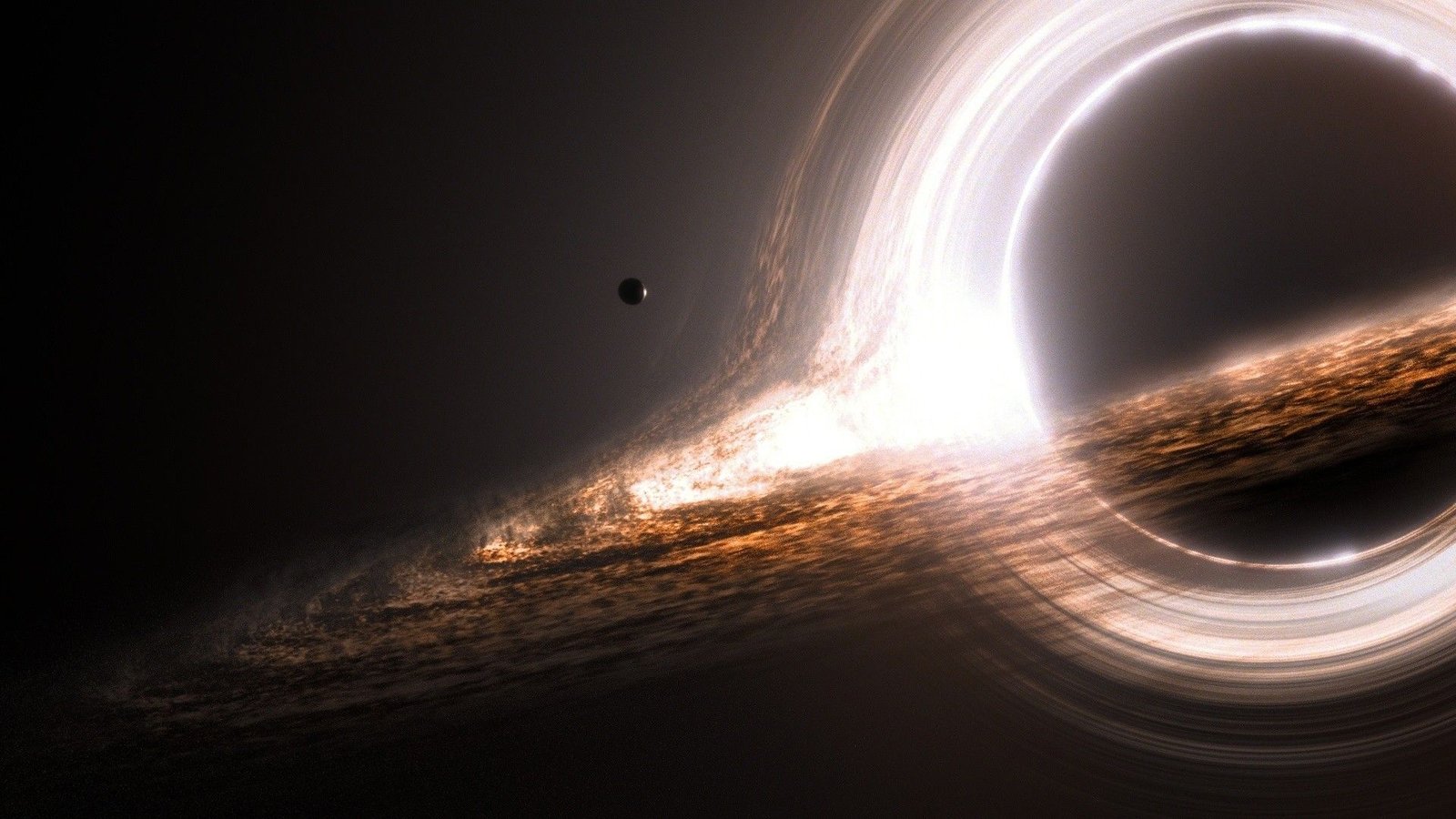
The name is technically misleading. While the interior of a black hole’s event horizon is indeed a region from which nothing, including light, can escape, the environment immediately surrounding a black hole is often among the most luminous in the known universe. Material falling toward a black hole forms an accretion disk — a flattened structure of superheated plasma orbiting the black hole at velocities approaching the speed of light, reaching temperatures of millions of degrees and radiating brilliantly across the electromagnetic spectrum from radio waves to X-rays.
Recent high-cadence X-ray observations of black hole accretion disks have revealed that this radiation is not steady but flickering — fluctuating in brightness on timescales ranging from milliseconds to hours in patterns that encode information about the geometry of spacetime in the black hole’s immediate vicinity. The study of these quasi-periodic oscillations has become one of the most powerful tools for measuring black hole masses and spins without direct imaging. In 2023, researchers using NASA’s Imaging X-ray Polarimetry Explorer — IXPE — obtained the first measurements of the polarization state of X-rays from black hole accretion disks, revealing the geometry and magnetic field structure of the corona above the disk with a precision that was previously unattainable and confirming that the extreme physical processes occurring there match the predictions of general relativity with remarkable fidelity.
5. Light Can Escape From Behind a Black Hole — Sort Of
In 2021, astronomers made an observational confirmation of one of the strangest predictions of Albert Einstein’s general theory of relativity: light emitted from behind a black hole, which should be impossible to observe directly, can in fact be detected — because the black hole’s extreme gravity bends the paths of those photons around itself, redirecting them toward a distant observer.
The phenomenon, called gravitational lensing of the black hole’s own emissions, was observed when astronomers studying the X-ray corona of the supermassive black hole in the galaxy I Zwicky 1 detected bright flashes of X-ray light that first arrived from the corona in front of the black hole, followed milliseconds later by additional echoes of the same flares — fainter, arriving from a slightly different direction, and showing a wavelength shift consistent with having traveled a longer path around the back of the black hole before reaching the telescope. Einstein’s equations had predicted this effect for over a century. Observing it directly, as it happens in real time, was nevertheless a striking confirmation that spacetime truly is curved in the dramatic way that general relativity describes — and a demonstration that black holes are observable through their gravitational influence on light in ways that go far beyond simple imaging of their surrounding disks.
6. Black Holes Were Growing Too Fast in the Early Universe — and We Don’t Know How
Among all the mind-blowing facts about black holes currently challenging theoretical astrophysics, perhaps the most fundamentally troubling is this: the universe’s earliest epochs, when it was less than a billion years old, somehow contained supermassive black holes with masses of billions of solar masses — objects that, according to standard models of black hole growth, should have required far longer than the available time to accumulate that much matter.
The standard growth mechanism for black holes — the Eddington-limited accretion of surrounding material, in which radiation pressure from the infalling gas limits the rate at which a black hole can consume matter — predicts that even the most optimistic growth scenarios cannot build a billion-solar-mass black hole in less than several hundred million years, starting from a stellar-mass seed. Yet the James Webb Space Telescope has now detected multiple quasars — luminous, actively feeding black holes — existing when the universe was only 400 to 700 million years old, and these objects are already extraordinarily massive. Something allowed those black holes to grow dramatically faster than the standard model permits, and the explanation remains genuinely unknown. Proposed solutions include super-Eddington accretion phases, massive direct-collapse black holes that bypassed the stellar-mass stage entirely, and rapid mergers in dense early-universe environments — but none has been definitively confirmed.
7. Stellar-Mass Black Holes Are Hiding Throughout the Milky Way in Enormous Numbers
For most of the history of black hole astronomy, the objects were detected either by their electromagnetic emissions during active accretion phases or, more recently, by the gravitational wave signatures of their mergers. This observational bias meant that the census of black holes in the Milky Way was dramatically incomplete — most stellar-mass black holes, formed by the deaths of massive stars throughout the galaxy’s history, are isolated objects with no nearby material to accrete and no impending mergers to radiate gravitational waves. They are, in the most literal sense, dark.
ESA’s Gaia mission — which has been mapping the positions, motions, and properties of over a billion stars with extraordinary precision — has recently opened a new pathway to finding these hidden black holes through their gravitational influence on nearby companion stars. In 2022 and 2023, Gaia data were used to identify several stellar-mass black holes by detecting the subtle wobbles they induce in the orbits of binary companion stars — a technique called astrometric binary detection. The first such confirmed detection, a black hole named Gaia BH1 located approximately 1,560 light-years from Earth, is the closest black hole to our solar system ever confirmed. Subsequent discoveries have added to the tally, and astronomers believe the full Gaia dataset may eventually reveal dozens or hundreds of previously unknown black holes in our stellar neighborhood, suggesting the total population of stellar-mass black holes in the Milky Way may be far larger than the few thousand currently documented — potentially numbering in the tens of millions.
8. Black Holes Can Trigger Star Formation Rather Than Just Destroy It
The conventional picture of a supermassive black hole’s relationship with its host galaxy has long emphasized destruction — the powerful jets and radiation from an actively feeding black hole can heat and disperse the gas in its galaxy, shutting down star formation and effectively putting the galaxy’s growth on hold. This process, called AGN feedback, is a cornerstone of models of galaxy evolution and is invoked to explain why the most massive galaxies in the universe have relatively old stellar populations with little ongoing star formation.
Recent observations have complicated and enriched this picture considerably. In several systems, the jets from active black holes have been observed to compress gas clouds in their path, triggering star formation rather than suppressing it — a process astronomers call positive feedback or jet-induced star formation. The galaxy Minkowski’s Object, for instance, shows a chain of young, blue star clusters aligned precisely with a radio jet emanating from a nearby active black hole, suggesting the jet’s pressure wave is driving the collapse of gas clouds that then ignite as new stars. The relationship between supermassive black holes and star formation in their host galaxies is therefore bidirectional and context-dependent — black holes can both kill star formation and create it, depending on the geometry, energy output, and surrounding gas density of each specific system.
Frequently Asked Questions (FAQ)
Q: What are the most recent discoveries about black holes? Recent black hole discoveries include the detection of the nearest known black hole to Earth via Gaia satellite data, the first measurement of X-ray polarization from a black hole accretion disk using NASA’s IXPE telescope, observations of supermassive black holes in the very early universe that grew faster than standard models permit, identification of candidate kicked black holes racing through intergalactic space after gravitational wave recoil events, and growing evidence that black holes can trigger star formation in addition to suppressing it.
Q: Can light really escape from behind a black hole? Light cannot escape from within a black hole’s event horizon — that boundary remains absolute. However, light emitted from regions behind a black hole can be bent around it by the extreme gravitational curvature of spacetime, reaching an observer on the other side through a process called gravitational lensing. This was directly observed in 2021 when X-ray echoes from behind the black hole in galaxy I Zwicky 1 were detected arriving at a telescope seconds after direct emissions from the same flare, traveling the longer path around the black hole’s gravity well.
Q: How do scientists detect black holes that they cannot see directly? Scientists detect black holes through multiple indirect methods. Stellar-mass black holes in binary systems are identified by their gravitational influence on companion stars and by X-ray emissions from accreting material. Gravitational wave detectors like LIGO and Virgo detect the spacetime ripples from merging black holes. Astrometric surveys like Gaia detect the orbital wobble black holes induce in binary companion stars. Supermassive black holes are identified by the orbital velocities of stars near galactic centers and by the emissions from active accretion disks. The Event Horizon Telescope directly images the shadow cast by the largest and nearest supermassive black holes.
Q: How big can a black hole get? The upper limit on black hole mass is not theoretically well-constrained by current physics. The largest confirmed black holes — ultramassive objects in massive galaxy clusters — are estimated at 40 to 66 billion solar masses. Some theoretical models suggest that black holes could potentially grow to hundreds of billions of solar masses in sufficiently dense environments over cosmic time, though observational confirmation of objects at that scale remains elusive. The fundamental question of whether there is a physical upper limit to black hole mass is still an open one in theoretical astrophysics.
Q: What happens if two black holes collide? When two black holes merge, they spiral together in an event that releases an extraordinary quantity of energy as gravitational waves — ripples in spacetime that propagate outward at the speed of light. The merged black hole is typically less massive than the sum of its progenitors because a fraction of the total mass-energy is radiated away as gravitational waves. If the two black holes have unequal masses or misaligned spins, the asymmetric gravitational wave emission creates a recoil that can kick the merged object at velocities of hundreds to thousands of kilometers per second — potentially enough to eject the resulting black hole from its host galaxy entirely.
Conclusion: The More We Learn About Black Holes, the More Extraordinary the Universe Becomes
There is a particular irony in the fact that the universe’s most invisible objects — regions of spacetime so extreme that nothing can escape from them — have become among the most scientifically productive subjects in all of modern astronomy. Black holes that can never be seen directly have nevertheless been photographed through the shadow they cast. Black holes that make no sound have nevertheless been heard through the pressure waves they drive through intergalactic gas. Black holes billions of light-years away have had their masses, spins, and accretion geometries measured to surprising precision through the polarization of the X-rays their surroundings emit.
The ten facts about black holes explored in this article are not curiosities at the edge of respectable science. They are frontier results from the most sophisticated observational programs ever trained on the cosmos, using instruments that represent the accumulated engineering ingenuity of thousands of scientists and engineers across multiple generations. And every one of them points in the same direction: the universe is more extreme, more dynamic, and more deeply strange than any previous generation of scientists had the tools to appreciate.
Black holes are not merely the graves of massive stars or the silent engines at the centers of galaxies. They are windows — the most extreme windows available — onto the deepest workings of spacetime itself. Every observation we make of them, every gravitational wave we detect, every X-ray echo we trace, every distant quasar whose impossible early existence we struggle to explain, is a message from the universe about what reality is made of at its most fundamental level.
We are only beginning to decode that message. And if the recent pace of discovery is any guide, the next decade will bring revelations that make the current ones look like a prologue.
0 thoughts on “10 Mind-Blowing Facts About Black Holes That Scientists Just Discovered”